Off-plan properties
Urban development is undergoing a structural transformation. Cities are shifting away from car-dependent models toward integrated, human-centered environments, where daily life is organized around proximity rather than distance.
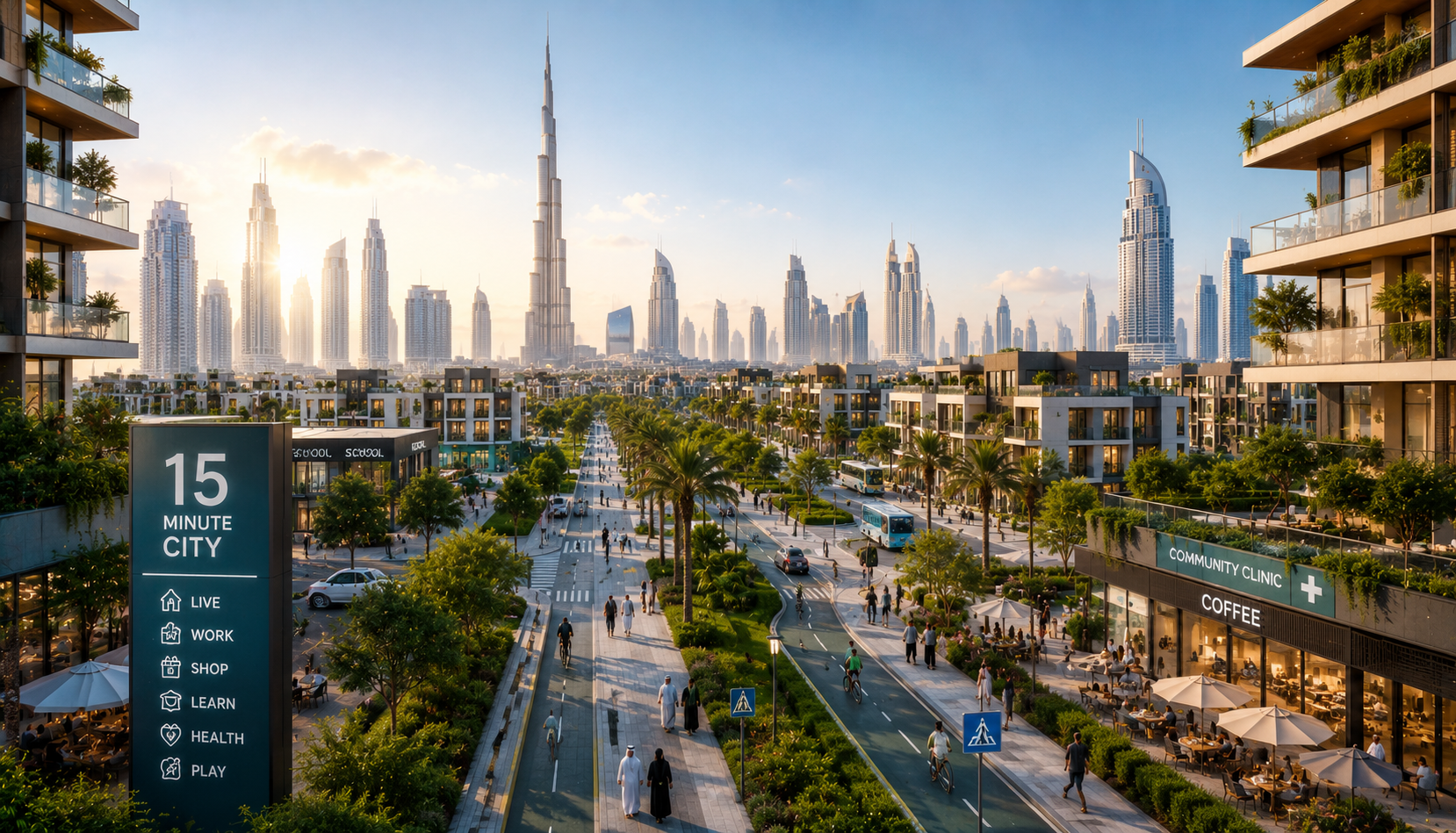
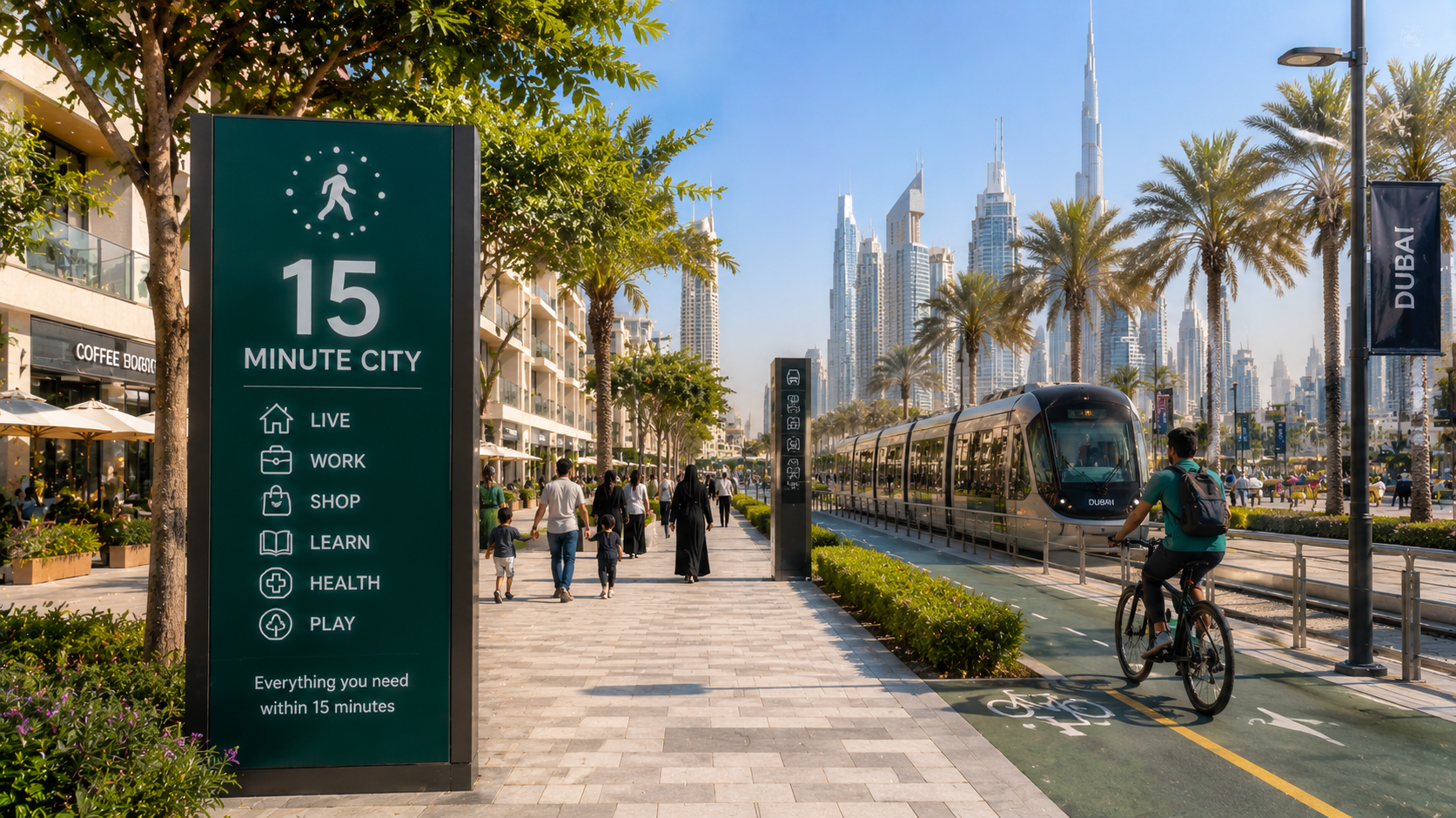
One of the most influential concepts behind this shift is the 15-minute city. While it originated in urban planning theory, today it directly impacts how real estate is designed, priced, and invested in — including in Dubai.
For investors, relocators, and property buyers, understanding this concept is no longer optional. It is becoming a key filter that determines demand, liquidity, and long-term ROI.
At its simplest, a 15-minute city is an environment where residents can access essential services within a 15-minute walk or bike ride.
However, the real meaning goes deeper.
It is not about distance alone — it is about functional self-sufficiency. A properly designed community allows residents to:
— within a single, integrated ecosystem.
This fundamentally changes urban behavior. Instead of commuting between disconnected zones, daily life becomes localized.
For real estate, this creates a critical shift: demand concentrates within well-designed communities rather than being spread across the city.
The rise of the 15-minute city is driven by structural changes in how people live and work.
First, there is a clear shift toward time efficiency. Long commutes are increasingly viewed as a negative factor, especially among professionals and families.
Second, cities are under pressure to improve livability and sustainability, reducing congestion and creating walkable environments.
Third, demand is shifting toward lifestyle-driven living — where access to cafes, parks, retail, and services is integrated into daily life.
For developers, this is not just an urban concept — it is a commercial strategy. Projects built around this model tend to generate stronger and more stable demand.
A 15-minute city is created through master planning, not individual buildings.
Core components include:
The key factor is balance.
A successful community is not defined by the presence of amenities alone, but by:
If these elements are misaligned, the concept becomes superficial — even if all components technically exist.
Dubai has been actively implementing this concept through large-scale master communities.
Dubai Hills Estate is one of the most complete examples of a functioning 15-minute environment.
It includes:
The strength lies in operational infrastructure, not just planning.
From an investment perspective, this results in:
Dubai Creek Harbour represents a forward-looking implementation of the concept.
Key features:
However, its value is partially future-dependent.
For investors, this means:
This type of community is suited for growth-focused strategies rather than immediate yield.
JVC provides a more accessible version of the concept.
It offers:
This supports:
However, compared to premium communities, it has limitations:
It performs well, but does not represent a fully optimized 15-minute model.
One of the most overlooked factors in Dubai is internal supply pressure.
Master communities often contain:
At the time of completion, your property will compete with:
This can lead to:
Even in well-designed communities, oversupply can weaken short-term performance.
Professional investors always evaluate:
From an investment perspective, integrated communities tend to outperform traditional areas.
Convenience significantly increases tenant interest.
Tenants are less likely to leave self-sufficient environments.
Families and long-term residents prefer integrated communities.
Demand remains stable even during market fluctuations.
This results in more predictable and stable ROI.
The 15-minute model is not universally applicable.
Limitations in Dubai include:
Additionally, some premium locations prioritize:
— over accessibility.
This means that not all high-value properties benefit from this concept.
Developers increasingly market projects as “self-sufficient communities.”
However, there is a critical difference between:
In many cases, projects simulate the concept rather than implement it.
Typical issues:
Investors must distinguish between: what exists today vs what is promised.
The most frequent mistakes include:
One of the most critical errors: buying into a “concept” that is not yet operational.
The 15-minute city is no longer just a lifestyle concept — it is an investment filter.
Demand is increasingly concentrated in:
Choosing the wrong area today often leads to:
What is a 15-minute city in simple terms?
A community where daily needs are accessible within a short walking or cycling distance.
Does Dubai fully follow this concept?
Not entirely, but several master-planned communities strongly align with it.
Is it important for investment?
Yes. It directly affects demand, occupancy, and long-term performance.
Are all new developments 15-minute communities?
No. Many projects only partially implement the concept or rely on future infrastructure.
Does it affect property prices?
Yes. Integrated communities typically show stronger demand, better liquidity, and more stable growth.
In a market where many projects are positioned as “integrated,” identifying real opportunities requires deeper analysis.
DDA Real Estate helps investors:
We focus on identifying locations where demand will be strongest at completion — not just today. In modern real estate markets, infrastructure and lifestyle are no longer secondary factors — they define demand. The 15-minute city concept reflects this shift and provides a practical framework for evaluating locations.
If you are considering real estate investments in Dubai, a structured, data-driven approach to selecting communities is essential for achieving strong long-term results. DDA Real Estate provides access to high-quality projects, early-stage opportunities, and data-driven investment strategies tailored to your goals.